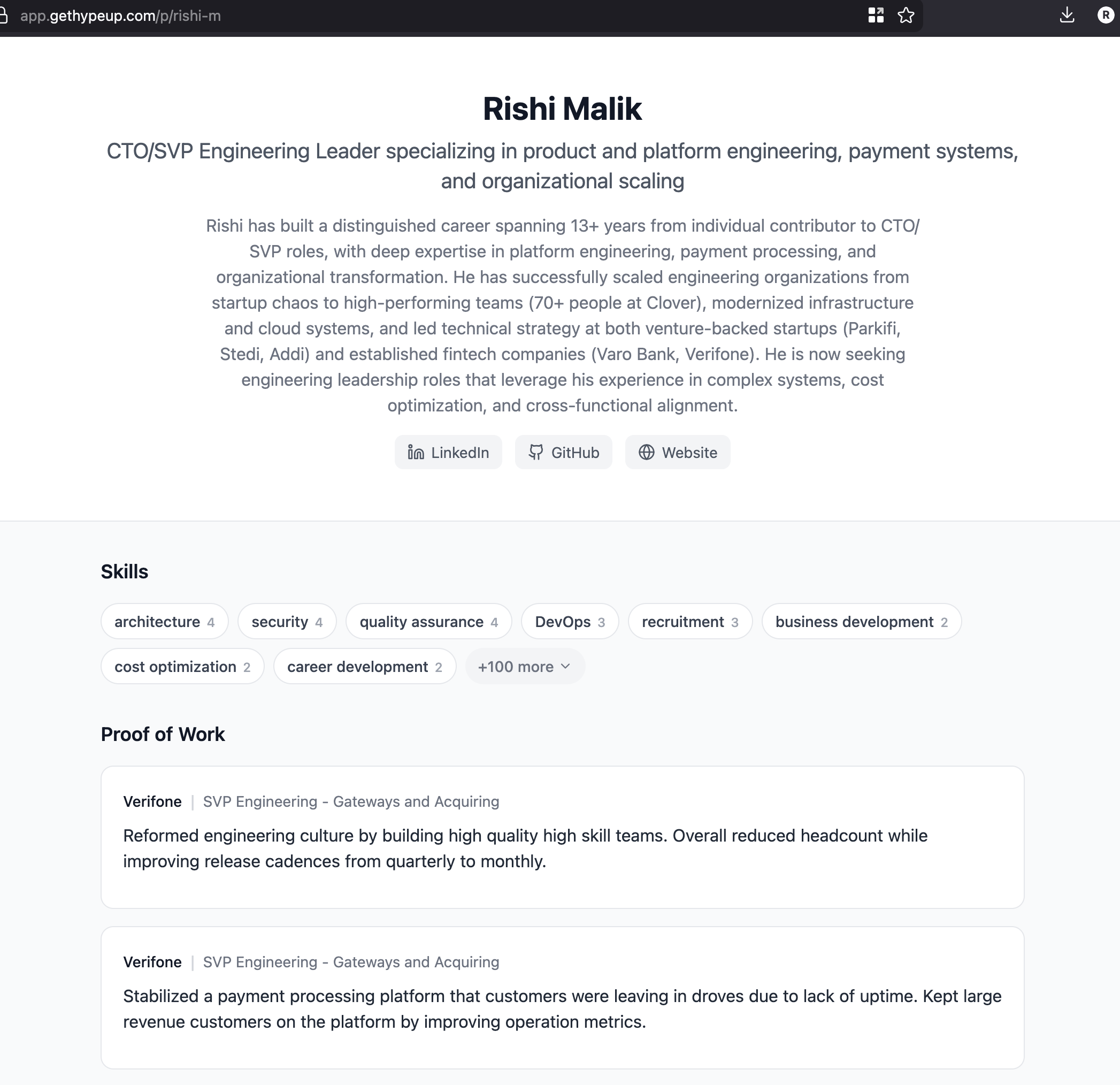
Last week, Business Insider published a piece that crystallized something I’ve been feeling for a while: hiring managers aren’t reading resumes anymore. The article, by Amanda Hoover, lays out the damage that AI-generated resume slop has done to the hiring process. Recruiters are drowning in polished-but-hollow applications. Companies like Gumroad and Automattic have stopped requiring resumes entirely. A startup called Vamo is searching GitHub to find engineers by what they’ve actually built rather than what they claim on paper.
The money quote from the piece came from Michelle Volberg, CEO of recruiting software company Twill, who compared AI-polished resumes to a restaurant with a gorgeous menu but nobody in the kitchen making the food.
I build HypeUp, an AI-powered resume builder. So yeah — this article hit close to home.
The Problem With Being a “Resume Builder” in 2026
HypeUp was never just a resume builder. The core insight was always about the flywheel: log your career accomplishments as they happen, build a library over time, and generate better resumes from richer material. That’s still valuable. The accomplishment library is a genuinely differentiated asset that compounds.
But the output — the thing you hand to a recruiter — is still a PDF. A one-page document. The very thing that 70% of employers are now deprioritizing in favor of skills-based hiring. The thing that hiring managers are, in some cases, literally throwing on the floor.
So I did what I always do when reality shifts under me: I wrote a spec and started building.
Well, let’s be clear. I prompted Claude to write a spec, and started building.
Proof of Work Portfolio
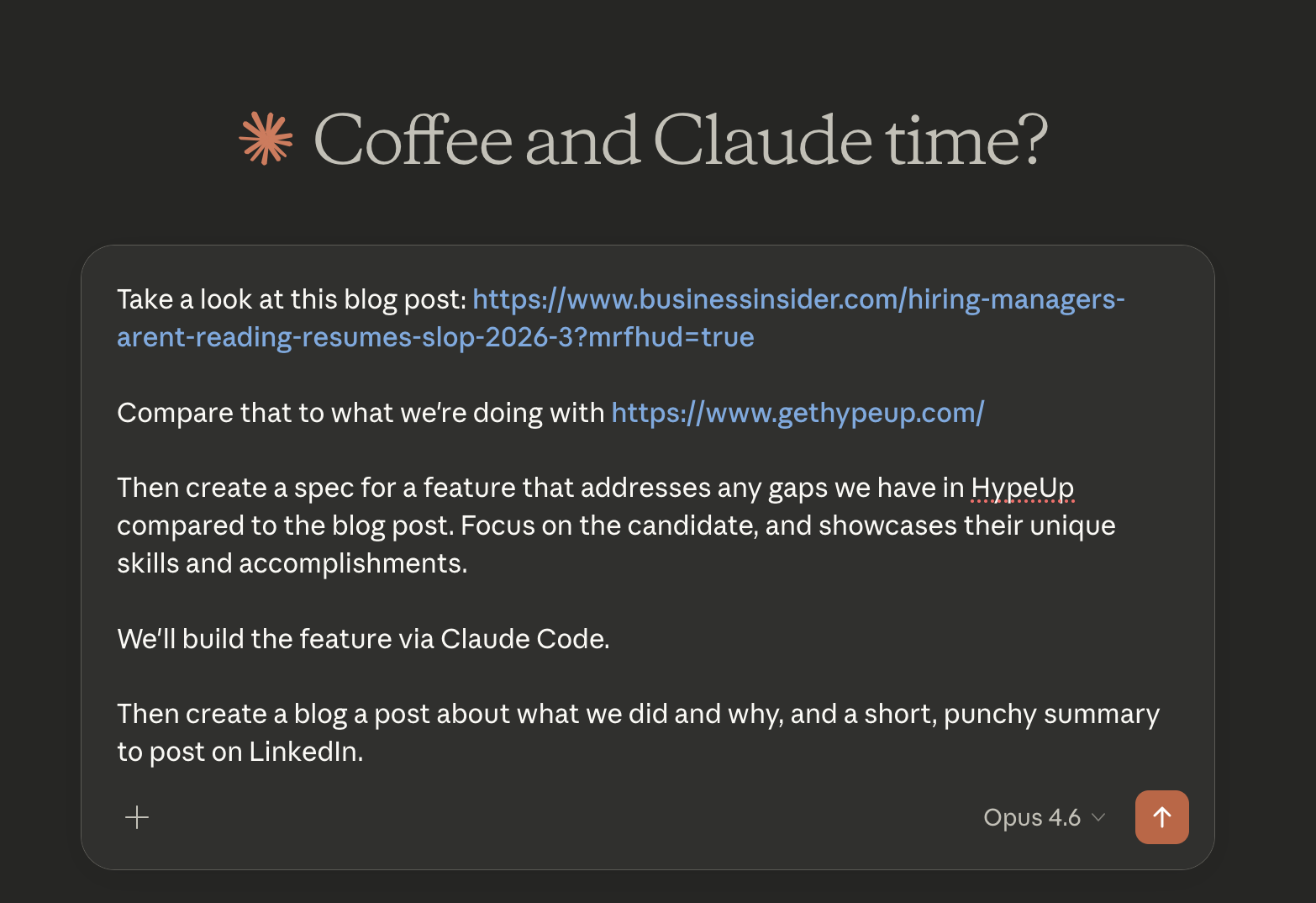
The new feature is called Proof of Work Portfolio. It’s a shareable, public portfolio page generated from your HypeUp accomplishment library. It’s not a resume. It’s a curated, evidence-backed showcase of what you’ve actually done.
Here’s what it looks like:
A Skills Map — not self-assessed skill bars (those are meaningless), but a visual grid of skills where each one is backed by actual accomplishments. Click “Python” and you see the three projects where you used it and what you shipped.
Proof Cards — each accomplishment becomes a card with evidence attached. Links to the GitHub repo, the live demo, the case study, the Figma file. Metrics badges showing quantified impact. Optional screenshots. This is the stuff that can’t be faked with a ChatGPT prompt.
A Personal Narrative — a short intro and a “what I’m looking for” tag. Optional video embed. Because the article is right: recruiters want signal on who you are, not just what you’ve done.
A Shareable URL — something like gethypeup.com/p/rishi-m that you can drop in a LinkedIn DM, an email to a hiring manager, or your Twitter bio. No PDF attachment needed.
Why This Matters
The Business Insider article identifies several trends that all point in the same direction:
Skills > credentials. NACE found 70% of employers are using skills-based hiring. LinkedIn launched skill verification with Replit and Lovable. HypeUp’s Skills Map directly addresses this — skills backed by proof, not self-assessment.
Show your work. Vamo finds engineers by their GitHub repos. J.T. O’Donnell says posting about your projects on LinkedIn is how you get found in the “quiet hiring” era. Proof Cards with evidence links are exactly this.
Be human. Indeed is testing instant video interviews. Recruiters want to see personality. The portfolio’s narrative section and optional video embed give candidates a way to be more than bullet points.
Anti-slop. The whole point is that evidence links can’t be generated by AI the way resume bullet points can. A link to a live demo is proof. A link to a GitHub repo is proof. A screenshot of a dashboard you built is proof. This is the antidote to the trust crisis.
Building With AI
I specced this feature out in a single session with Claude, going from the Business Insider article to a full gap analysis to a prioritized feature spec. The spec includes data model changes, user flows, MVP vs. V2 scope, pricing tier integration, and success metrics.
The actual build will happen agentically — the same way I’ve been building HypeUp from the start. The portfolio page will be server-rendered (public, no auth, SEO-friendly), the editor will live in the existing dashboard, and the Skills Map aggregation will compute on read so it always reflects the latest state of someone’s accomplishment library.
This is the part I love about building with AI tooling: the cycle from “industry just shifted” to “spec complete, ready to build” can happen in an afternoon. The article dropped March 3rd. The spec was done March 10th. The code ships next.
The Bigger Picture
HypeUp’s thesis has always been that your career record should compound over time. The resume flywheel still works — it’s still better to generate a tailored resume from a rich library than to start from scratch. But now the flywheel feeds two outputs: a traditional resume and a Proof of Work Portfolio.
The more you use HypeUp, the stronger both become. And the portfolio — because it’s public, because it’s shareable, because it’s backed by real evidence — becomes a growth channel too. Every portfolio page is a potential new user seeing what HypeUp can do.
Resumes aren’t dead yet. But they’re no longer enough. The candidates who win in 2026 will be the ones who can show their work, not just describe it. That’s what we’re building.
HypeUp is an AI-powered career system that helps you track accomplishments and generate tailored resumes. The Proof of Work Portfolio is live, come try it out! Sign up free and start building your library now.